
What makes a public agency capable?
I went to graduate school with a practical question: when political leaders take on an ambitious economic or climate agenda, what kind of organization is needed to carry it out?
My 2023 master’s thesis at Tufts, A Form of Government Capable of Accomplishing the Agenda of the Hour, took its title from Keynes and its case from the Massachusetts Clean Energy Center (MassCEC), an agency that combines clean-energy economic development with efforts to change how markets adopt climate technologies.
Study the organization in context
Four questions about the agency
Purpose
What is it trying to accomplish?
Empowerment
What authority and institutional position does it have?
Approach
What interventions does it use?
Organization
How does it arrange the capability to deliver?
I combined research on microeconomic policy with theories of organizational effectiveness and public-agency dynamism, and built a framework around four dimensions: purpose, empowerment, approach, and organization.
I applied it through document research, board meetings and public presentations, and about 30 hours of interviews with 17 people, including current and former agency leaders, a former state energy secretary, and outside partners.
There was no written history of MassCEC, so I wrote one. It traces how the agency was formed inside state government, how its mandate shifted between administrations, and how its programs grew out of those choices. That history, and the connection between it and the theory, is the part of the thesis I’m proudest of. Accounts of how a public institution actually takes shape are not always written down.
Two opportunities for agency leadership
I also distilled the research into a short presentation for MassCEC leadership with two recommendations. They were written for a particular moment and depend on a political climate that has somewhat changed, but they show how the analysis translated into choices a leadership team could make.
Clarify the different purposes
The analysis identified four related but distinct purposes: Cleantech Cluster Support, Offshore Wind Industry Support, Green Market Transformation, and Just Transition. Each had its own history, intended outcomes, and reason for public intervention. Naming them separately would help the agency more clearly explain its work and actually measure its disparate programs against appropriate goals.
Connect strategic leadership with program expertise
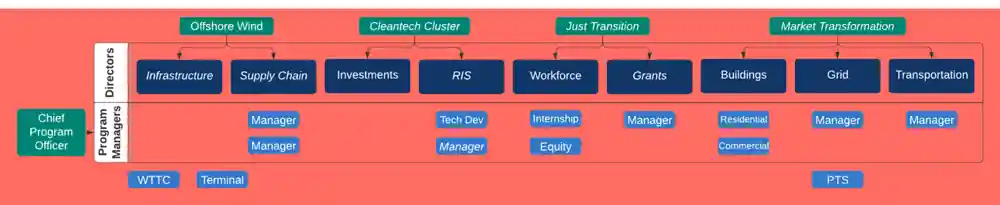
MassCEC needed people shaping opportunities and industry relationships, and people expertly running programs and grants. I proposed a matrix structure to give both roles attention and connect them.
Bring the research into an organizational conversation
The thesis has found readers inside the agency. MassCEC’s current CEO, Ben Downing, has read it, and former Chief Program Officer Galen Nelson wrote in a public post about reading it multiple times and finding it useful.